
What on earth is nervous system regulation?
Everyone seems to be talking about it online, but what does it actually mean to regulate your nervous system?
First, some very summarised science
Let’s start with the basics.
Our nervous system is divided into two main subsystems - the central nervous system (CNS) which includes our brain + spinal cord, and the peripheral nervous system (PNS) which regards all the nerves that reach every part of our body.
The PNS is divided further into the somatic nervous system (controls voluntary movement) and the autonomic nervous system (ANS, which controls automatic functions e.g. breathing, heart rate + digestion) which is what we’ll focus on.
The ANS has two separate branches that work in opposite ways:
Sympathetic pathways increase activity to the organs and help us with life-threatening situations.
Parasympathetic pathways decrease activity to the organs and help calm the body down, allowing for normal function.
They need to be able to work in tandem and balance each other out as required.
The 3 key states to know
That brings us onto the three functional states that our nervous system can move through:
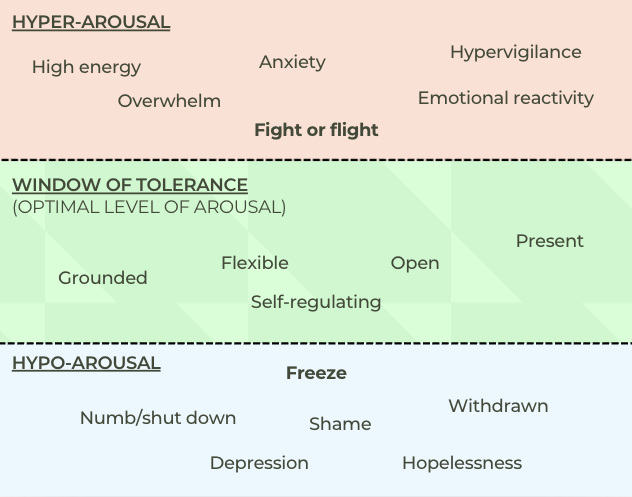
A healthy nervous system is flexible, adaptable and can move through all of these states with ease.
Ideally we are able to manage a range of emotions, stressors, and daily life without becoming overwhelmed or shut down. Responding to life as it happens, and moving between states seamlessly.
Dysregulation happens when the demand on the nervous system exceeds its capacity
When life and stress pushes you outside of the optimal window of tolerance, it’s possible to get stuck in one of these two states:
→ Chronic hyper-arousal
Also known as ‘Fight or Flight’, this is where our sympathetic nervous system becomes activated, perceiving a threat or excessive stress. Our heart rate rises, alertness increases + digestion slows down to respond to the situation.
This was built for immediate threats, not permanence - yet many of us are always ‘on’, living in chronic stress and experiencing burnout - which causes sustained arousal and fight-or-flight activation.
→ Chronic hypo-arousal (also known as dorsal vagal shutdown)
Here we get ‘frozen’ in a parasympathetic state of numbness, disassociation and fatigue. This is conservation mode. It’s often a response to overwhelming stress or trauma and it can cause digestive issues, tension in the body and brain fog.
These nervous system reactions happen because we don’t feel safe, and our window of tolerance may be narrowed - especially if we’ve experienced trauma and have become primed to detect threat.
The result = struggling to go into parasympathetic recovery (rest and digest)
In parasympathetic recovery digestion starts up, hormones regulate and balance, tissues repair, energy is stored. We feel more relaxed and present as the body is at rest.
Essentially, dysregulation affects everything:
Hormone balance
Gut health
Sleep
Energy for life
Mental outlook
Presence
Motivation
Empowerment
Vibrance
Building towards regulation
You can’t cold plunge, supplement or ‘hack’ your way out of dysregulation.
Building towards regulation takes time and consistent practices that support you and work to establish a new baseline.
The goal is to live mostly from the window of tolerance (and expand its capacity) as this is where we can exist in a state of balanced arousal where the sympathetic and parasympathetic branches function together smoothly.
It’s where we are open, engaged, able to process emotions and handle what life brings day-to-day.
We can achieve that through regulation.
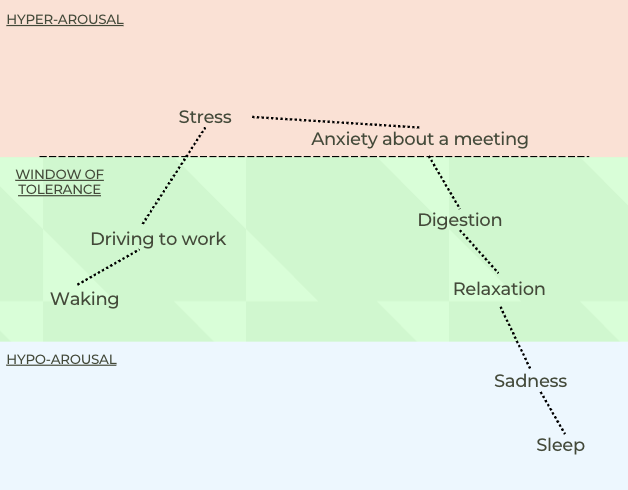
An example of how a healthy nervous system flows between states throughout the day.
How to approach nervous system regulation depending on your state:
Chronic hyper-arousal
If you are in chronic hyper-arousal, you’ll want to spend more time doing down-regulating practices, like:
Breathing exercises like 4-7-8, 4-6 and box breathing
Calming meditation
Humming to stimulate the vagus nerve
Legs up the wall
Intuitive movement
54321 technique for anxiety
Chronic hypo-arousal
Focus on up-regulating the nervous system through:
Deep breathing
Guided visualisation meditation
Somatic shaking
Dancing
Yoga
EFT Tapping
Butterfly hug
54321 technique to navigate overwhelm
It’s also about signalling safety to our nervous system, through:
Slowing down and not rushing
Taking the pressure off yourself
Releasing stored tension and emotion
Completing stress responses
Resting when you need to
Practicing self-compassion
Being more present
Honouring your needs
Routine + consistency
Learning to embody safety
Building self-trust
Healthy boundaries
Embracing play
Nurturing safe connections
And restoring the nervous system from the foundations:
Adequate, consistent sleep
Movement
Healthy + enough food
Frequent rest
Sunlight
Regulating your nervous system will activate powerful change in your physiology, lifestyle and way of being. It’s how you’ll turn on your vibrance and create a life you can truly thrive in.
We are very grateful to be the one’s to support you on your nervous system regulation + self-growth journey.
